

Sinningia Eumorpha
CHF 41.00

The Sinningia Collection at TOMs FLOWer CLUB brings together one of the most fascinating yet surprisingly underappreciated groups of flowering plants in cultivation. These remarkable species and hybrids are closely related to African violets and belong to the Gesneriad family, but they possess a character entirely their own. Many develop sculptural underground tubers, attractive foliage and spectacular tubular flowers that seem almost too exotic for plants that can be grown successfully on a windowsill.
This collection is intended for curious plant lovers, collectors and anyone interested in unusual botanical diversity. Whether you are discovering Sinningias for the first time or searching for rare species, these plants offer a unique combination of beauty, adaptability and horticultural intrigue that few other genera can match.
Every collector eventually encounters a group of plants that makes them wonder why they are not far more widely grown. For me, Sinningias belong firmly in that category.
While orchids, aroids and succulents often dominate modern collections, Sinningias quietly occupy their own botanical niche. They combine spectacular flowering with unusual growth habits and remarkable adaptability. Some species remain compact enough for a windowsill, while others develop impressive caudex-like tubers that become increasingly attractive with age.
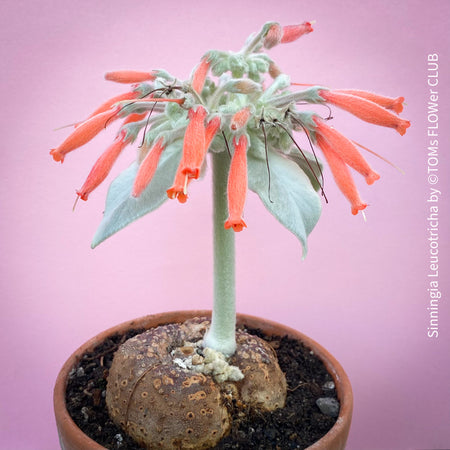
A mature Sinningia is often as interesting when not flowering as when covered in blooms. The exposed tuber, the texture of the leaves and the architectural growth habit create year-round interest.
Perhaps this is one reason why dedicated collectors tend to remain fascinated by them for decades.
Most Sinningia species originate from Brazil and neighbouring regions of South America, where they occupy a surprisingly diverse range of habitats.
Some grow on rocky outcrops exposed to intense sunlight. Others inhabit forest margins, cliffs or seasonally dry environments. This ecological diversity explains why Sinningias can vary so dramatically in appearance.
One species may resemble a delicate woodland flower while another develops a large exposed tuber and thick succulent stems.
Understanding these natural habitats helps explain many aspects of cultivation. Their famous tubers, for example, are not simply storage organs. They are survival mechanisms that allow the plants to withstand periods of drought and seasonal stress in the wild.
This adaptation is one of the reasons Sinningias are often far more resilient than they initially appear.
Many plant enthusiasts first become interested in Sinningias because of their flowers. Most stay because of the tubers.
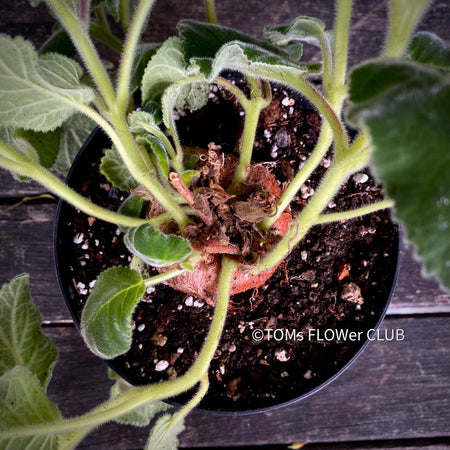
As plants mature, the underground tuber gradually enlarges and can become a sculptural feature in its own right. Older specimens often develop fascinating shapes and textures that make each plant unique.
Unlike many flowering houseplants that decline after blooming, Sinningias frequently become more interesting with age.
In my own collection, some of the most treasured plants are not necessarily those producing the largest flowers. They are the older specimens whose tubers tell a story of years, sometimes decades, of careful cultivation.
Patience is rewarded generously with this genus.
The flowers of Sinningias are extraordinary examples of plant-pollinator relationships.
Depending on the species, they may be adapted to hummingbirds, bees, butterflies or other pollinators. Their tubular forms, vibrant colours and elegant proportions reveal countless evolutionary refinements.
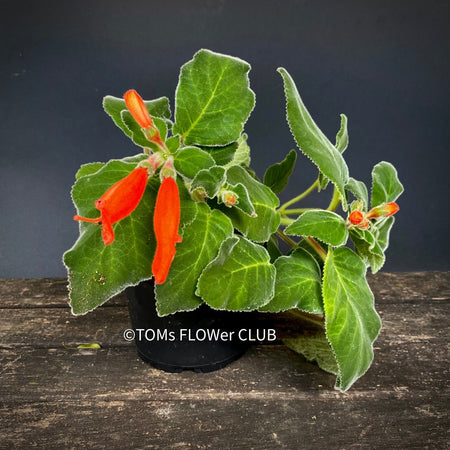
Flower colours range from brilliant reds and oranges to soft pinks, purples, whites and combinations thereof. Some species produce surprisingly large flowers relative to their overall size.
Unlike many seasonal bedding plants bred primarily for mass-market appeal, Sinningia flowers often retain the elegance and individuality of their wild ancestors.
For collectors interested in botanical authenticity, this is part of their enduring appeal.
One of the most common misconceptions is that Sinningias are difficult plants.
In reality, most species are relatively straightforward when their basic requirements are understood.
The key is recognising the rhythm of growth and dormancy.
Most species enjoy bright conditions, excellent drainage and moderate watering during active growth. During dormancy, many require significantly less moisture as the tuber rests before the next growing cycle begins.
Overwatering is usually a greater threat than temporary dryness.
A well-drained substrate is therefore essential. At TOMs FLOWer CLUB, we cultivate Sinningias in carefully prepared mixes designed to provide both aeration and moisture balance. Healthy roots and healthy tubers are the foundation of long-term success.
Collectors often joke that nobody owns just one Sinningia for very long.
There is some truth in that observation.
The genus offers extraordinary diversity. Species differ in leaf texture, flower shape, growth habit, tuber development and ecological adaptation. Each new species feels like discovering a completely different plant.
Some collectors focus on miniature species suitable for limited growing space. Others specialise in large-flowered forms or rare Brazilian species.
The deeper one explores the genus, the more fascinating it becomes.
Unlike fashionable plant trends that appear and disappear within a few years, Sinningias reward long-term curiosity and observation.
At TOMs FLOWer CLUB, Sinningias are cultivated according to the same philosophy that guides all plant collections.
Quality before quantity.
Plants are not pushed with excessive fertiliser to create temporary visual impact. Instead, they are grown slowly and steadily, allowing strong root systems and healthy tubers to develop naturally.
This approach requires more time, but the resulting plants establish more successfully and continue to perform for many years.
A Sinningia should not simply survive after purchase. It should continue evolving into an increasingly beautiful specimen.
That is always the goal.
After decades of growing orchids, bromeliads, succulents, caudiciform plants and countless other botanical groups, I continue returning to Sinningias.
They combine many qualities I admire in plants.
They are botanically fascinating.
They reward observation.
They improve with age.
They remain relatively uncommon.
And they remind us that some of the most remarkable plants are still waiting to be discovered by a wider audience.
In a world increasingly dominated by short-lived trends, Sinningias offer something more enduring.
I have always been drawn to plants that tell stories through their growth. Sinningias do exactly that.
Every season leaves its mark on the tuber. Every flowering cycle adds another chapter. Some specimens become companions for many years and reveal new details with each growing season.
Few plant groups combine beauty, individuality and horticultural fascination quite so elegantly.
For collectors, they are endlessly rewarding.
For newcomers, they are often unforgettable.
CHF 41.00

CHF 41.00


CHF 41.00


CHF 41.00


CHF 41.00


CHF 41.00


CHF 41.00
CHF 41.00